Showing posts with label Nomenclature. Show all posts

Monday, September 11, 2006

Situation Model Terms

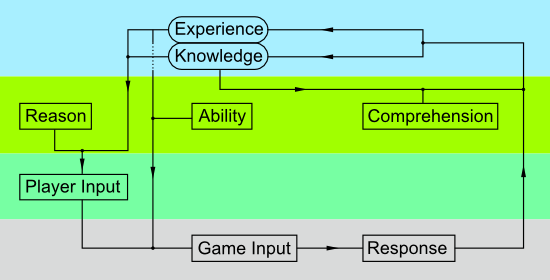
Situation: This is the particular set of Game Input that the game allows and the Results that the game will provide for those Inputs at the current state of the game. It involves the player confronting a particular state of the game and deciding how to interact with that state so as to produce a Result that the player considers favorable.

The Situation Model

Player Accumulated Wisdom


A player, when approaching a Situation, brings with him/her the following accumulated attributes:

Knwoledge: This represents the accumulated information that the player has about the game up until this point. This represents, among other things, the player's understanding of the current Situation, the player's understanding of what Input the player may provide to the game, and the player's knowledge of what happened previously. Knowledge may be obtained through the application of Comprehension (and previous Knowledge) to the Result of a prior Situation. It may also be obtained from extra-game sources (online FAQ, hints from a friend, etc).

Experience: This represents the accumulated ability of the player to manipulate the game's user interface. Experience may be acquired through the application of Comprehension and Knowledge to the Result of a prior Situation. Experience may be acquired through other extra-game sources (playing a similar game with a similar user interface, etc).

Fundamental Player Attributes


The player, in addition to accumulated wisdom, brings with him/her certain fundamental attributes of that player. These attributes do not change from Situation to Situation; they represent basic constructs of the particular person playing the game. As part of the Situation Model, these attributes fully define a specific person playing the game. They also do not change over time.

Reason: This attribute is used to process Knowledge and Experience to produce the Player Input that the player wishes to use in a particular Situation.

Ability: This attribute represents the player's skills at manual dexterity. This attribute is used, when coupled with the player's accumulated Experience, to transform Player Input into Game Input.

Comprehension: This attribute represents the player's skill at understanding what he/she is being presented with. It is used to generate new Knowledge and Experience, but previous Knowledge informs this process as well.

Player's Mind


These constructs take place entirely within the player's mind.

Player Input: This is the specific sequence of commands that the player would like to tell the game in order to meet the Situation and achieve a Result. Player Input is generated by applying the player's Reason to the player's body of Knowledge and Experience. Player Input is then entered into the game by applying the player's Ability to the player's body of Experience.

The Game


Game Input: This is the valid input that the game receives from the player. The player uses his/her Ability, informed by Experience, and the player's Player Input to generate this information. The game outputs a Result based on this input and the specifics of its game design.

Result: This is the output from the game's processing of the Game Input. It is based on the Game Input and the game's design. It can be transformed into the player's Knowledge and Experience when the player's Comprehension is applied to the Result, informed by the player's current Knowledge.

Mapping Table: For a specific situation, the Mapping Table is the set of all possible mappings from Game Input to Results in this Situation. These mappings may not be 1:1, and there can be random or chaotic elements in the Design, such that it makes it difficult for the player to predict whether a particular Game Input will produce a particular Result.

Friday, September 01, 2006

Game Pathologies

A Pathology is a disfunction within a game. A Pathology happens when the game designer intended one effect to happen, but something else did that significantly changes the progression of the game.

Note that a true Pathology is one that is fundamental to the game, built into the game design. As such, under the Situation Model, a Pathology only ever arises from things born of either the Game Input or the Results of some prior input.

A Faux Pathology is not a true Pathology. Because analysing a game's design is virtually impossible without considering some player's involvement, it is possible for a player to consider something a Pathology that isn't. For example, it might simply be a puzzle that the player lacks sufficient Reason to solve, but feels to that player like there is a critical piece of Knowledge missing. The line between a Faux Pathology and a real Pathology is somewhat blury.

A Critical Pathology is a Pathology that causes the game to no longer be functional at all. A non-critical Pathology may allow the game to still be interesting or fullfill its goal; a Cricial Pathology does not. Note that the game can still be progressable, but the intent of the game design is drastically damaged if not destroyed. Typically, this happens in one of the following ways:

  • The game does not allow the player to progress, thus frustrating the player and eventually forcing the player to stop playing.

  • The game forces the player to engage in unreasonable activity in order to progress. The player may continue playing, but the player will lose a significant quantity of enjoyment for the game.

  • The game becomes incredibly easy for the player, thus stripping out all challenge from the game.

  • The player is forced to use external aids (online FAQs, asking someone, etc) in order to progress.

  • A Knowledge Pathology is a Pathology in a game based on the Knowledge domain of the Situation Model. The game's design provides certain expectations about the player's Knowledge base, for later Situations will test those expectations. A Pathology develops if the player's body of Knowledge differs significantly from what the game expects the player to have at that particular Situation.

    There are two forms of this Pathology. A Negative Knowledge Pathology is merely when the game has not provided the player with a certain piece of Knowledge. Because the player's Comprehension is also a factor, it can inspire a Faux Pathology whereby the player simply lacks the comprehension necessary to deduce the Knowledge. The true form of the Pathology is when the game does not provide any Result that has some form of logical consequence that leads from that Result to Knowledge.

    A slightly alternate form of this Pathology is when the game provides a result, but it requires a Game Input that the player is not likely to provide. This is often due to a Knowledge Pathology that has already occurred, however, and is rarely encountered in the absense of other errors.

    The second form of Knowledge Pathology is the False Knowledge Pathology. False Knowledge happens as a true Pathology when the game expects the player to reason one thing, but given what the player knows, some other thing that is actually untrue seems more reasonable based on that Result. The Faux Pathology analog of this is when one's Comprehension is simply erronous, or otherwise different from what the game expects, and the player's logical deduction came to the wrong conclusion.